A Letter to Muslim Youth on Success, the Ballot, and the Return of the Khilafah
I. “Successes”?
This November, Muslim Americans are being told that history is turning in our favor. A Muslim now governs New York City. A Muslim physician from Detroit stands one election away from the United States Senate.[1] Many voices in our community, some of whom once warned us about the system, now assure us that it works, and that with enough votes and the right candidates, America will finally keep its promise.
Are these successes? By the measure of the evening news, perhaps. But a Muslim must ask a prior question: success by whose measure, and toward what end? Allah (swt) has already defined it: Whoever is drawn away from the Fire and admitted to Paradise has truly succeeded. And what is the life of this world except the enjoyment of delusion? (Al-Imran 3:185). A seat, a title, and a rising income are not success unless they serve the purpose for which we were created (Al-Dhariyat 51:56). Measured that way, the celebrations deserve a second look. The danger facing our generation may not be that we lose elections, but that we win a few seats and lose our imagination; not that America rejects us, but that it accepts us on its own terms. The Qur’an warns of exactly this: Istidraj, being drawn on step by step through apparent success (Al-A’raf 7:182). We cannot know Allah’s plan for any person. We can recognize the danger, and we can refuse to walk into it.
II. Accepted on Their Terms
Islam did not arrive in America with the immigrants of the 1960s. Historians estimate that roughly 10 to 30 percent of the Africans enslaved in North America came from Muslim West Africa.[2] One of them, Omar ibn Said, a scholar enslaved in the Carolinas, wrote his life story in Arabic in 1831 and opened it with Surah al-Mulk: Blessed is He in whose hand is the dominion (Al-Mulk 67:1).[3] Even in chains, he began with the question of sovereignty.
The system’s terms were visible even then. Abdul Rahman Ibrahima, a Muslim prince from Futa Jallon enslaved for forty years in Mississippi, was freed in 1828 after the Sultan of Morocco interceded with President John Quincy Adams, on the condition that he leave America. He could not buy freedom for most of his children, and he died in Liberia the next year without them.[4] Recognition came to one man. The system that held his people did not move.
Muslims in America today are a community of many roots: Black Americans, some descended from those enslaved West Africans, alongside immigrants and their children from South Asia, the Arab world, Africa, and beyond. For the immigrants, too, acceptance came with conditions. As late as 1942, a federal court in Detroit denied citizenship to a Yemeni Muslim, Ahmed Hassan, reasoning that Arabs belonged to “the Mohammedan world,” separated from Christian Europe by “a wide gulf.”[5]
In our own time, the community has tried both reward and punishment. In October 2000, the four leading national Muslim organizations jointly endorsed George W. Bush. By their own estimates, roughly seven in ten Muslim voters followed, including tens of thousands in a Florida decided by 537 votes.[6] Within a year came the Patriot Act, mass detentions, and the closure of Muslim charities. By 2004, his Muslim support had collapsed to about four percent.[7] In 2024 the community tried punishment instead. In Michigan’s Democratic primary, 56 percent of Dearborn voters and 61 percent of Hamtramck voters chose “uncommitted.”[8] In November, Dearborn, the heart of Arab and Muslim America, gave Donald Trump 42 percent, Kamala Harris 36 percent, and a third-party candidate 18 percent.[9] Within five months, the new administration barred entry from twelve countries, seven of them Muslim-majority.[10] Hamtramck’s then-mayor, who had helped deliver Muslim votes, was nominated ambassador to Kuwait, until a Senate controlled by his patron’s own party returned the nomination unconfirmed.[11] We rewarded one party in 2000 and punished the other in 2024. The ceiling did not move.
III. The Problem Is the Foundation
Why does the ceiling hold? Because the problem is not a party, a candidate, or any single interest group. It is the foundation itself. By Secular Capitalism we mean not three separate things but one ideology: a creed that separates religion from life, an economic system built on private ownership, interest, and markets, and a ruling system that places sovereignty with the people rather than with Allah (swt).[12] It measures a human being by what he produces and consumes. Its first casualty is purpose: the young professional who wins every prize it offers can still wake up asking what any of it was for. Its second casualty is every goal it does not share.
The system does not only set the terms of entry; it studies how to reshape those who enter. In 2004, the RAND Corporation, with private foundation funding, published Civil Democratic Islam, advising Western policymakers on which Muslims to cultivate: “modernists” first, “traditionalists” only tactically, and those it called “fundamentalists” to be opposed. It was a think-tank study, not law, but its opening premise was candid: “it is not easy to see who we should support and how.”[13] Islam itself had become a policy problem to be managed.
The terms are visible in those who rise. Michigan’s Senate nominee, known for opposing U.S. military support for Israel, describes himself as a capitalist; even so, the President greeted his primary victory by calling him “a Communist loser.”[14] New York’s mayor kept his predecessor’s police commissioner and apologized to officers for past criticism.[15] This is not a judgment on two men; it describes the terms of entry. Conformity buys a seat, not trust. Dissent is permitted on policy, never on the foundation.
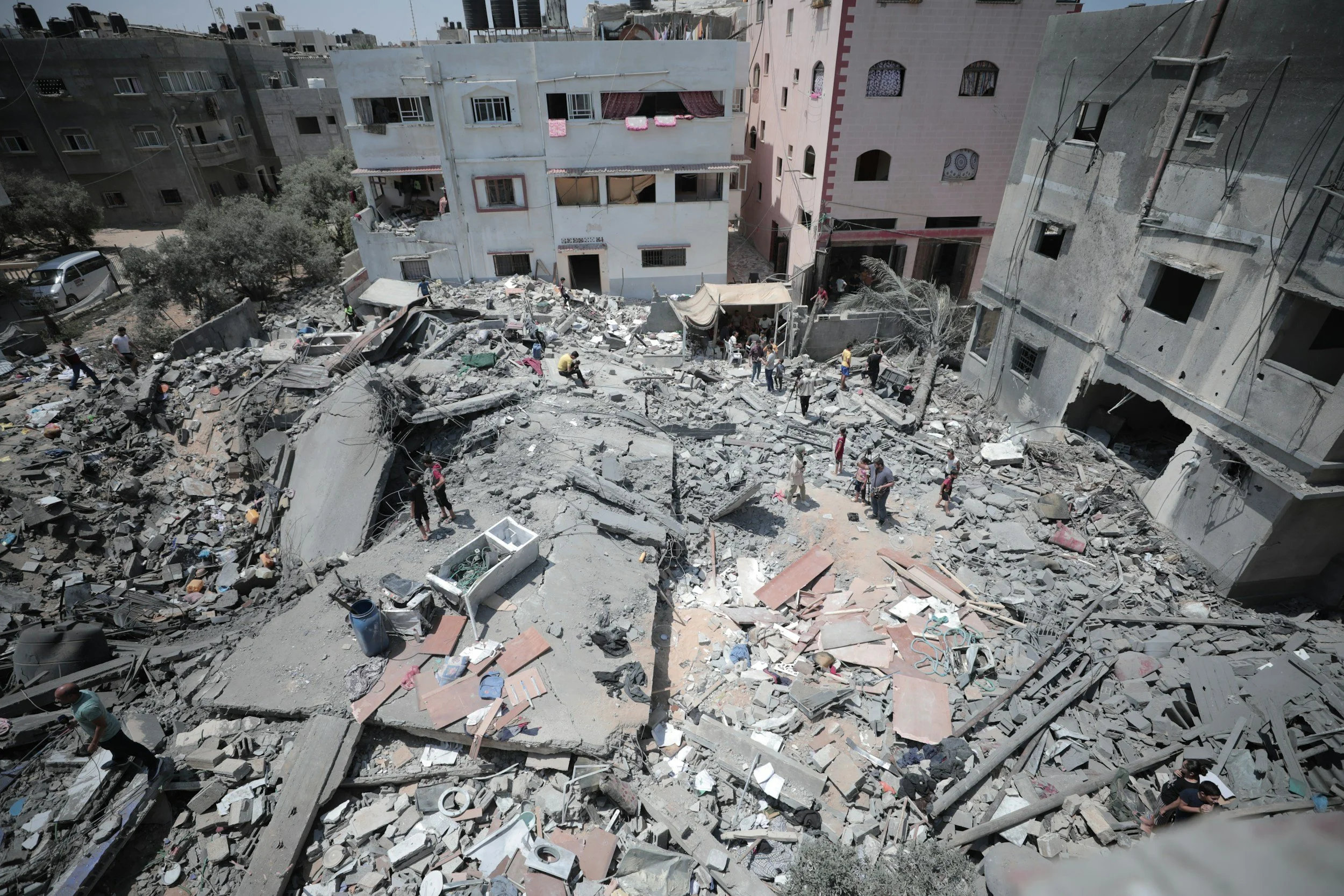
And where Muslim interests are truly distinct, the system does not bend. The destruction of Gaza, with at least 73,783 Palestinians killed by September 2026 according to Gaza’s Health Ministry,[16] was funded and defended by both parties across two administrations. At home, when Muslim parents in Maryland, joined by Catholic and Orthodox families, asked only to be notified and to excuse their young children from lessons that contradicted their faith, their county school board refused, and they had to go to the Supreme Court to win that right in June 2025.[17] Abroad and at home, on Gaza and on our own children, the lesson is the same. A system that cannot hear the Ummah’s most basic pleas will not be reformed by placing more Muslims inside it. The absence of hakimiyyah is not a policy gap that a better candidate can close.
IV. Publicity or Power?
Black America walked this road first. After centuries of slavery and nearly a century of legal segregation, the Civil Rights Movement won the Voting Rights Act of 1965. When the Joint Center for Political and Economic Studies opened in 1970, there were 1,469 Black elected officials nationwide; today there are more than 10,000.[18] Yet the gap in per-person wealth between white and Black Americans stopped closing after 1950 and has widened again since the 1980s.[19] Representation may have prevented worse; it did not change the condition. Even the Joint Center, founded to support those officials, concedes that representation alone does not guarantee systemic change.[20]
Malcolm X, the most influential Muslim in American history, saw the limits early. In April 1964, days before he left for Hajj, he urged that the struggle be lifted from “civil rights,” a domestic matter left to the very government that denied them, to “human rights,” so that the case could be taken “before the nations in the U.N.” He did not abandon the ballot; his new Organization of Afro-American Unity still planned to register voters.[21] But he refused to let the ballot be the horizon. He returned from Makkah speaking of a brotherhood that crossed every border, and he looked past the ballot toward the Ummah.
Contrast the electoral road with a movement that never sought office. The Nation of Islam, founded in Detroit in 1930 and headquartered in Chicago, taught Black Americans to “do for self.” Its theology departed sharply from Islam, and after 1975 many of its members followed Imam W. D. Mohammed into orthodox Sunni Islam. But its institutions were real: some 15,000 acres of farmland, dairies and warehouses, schools, and Muhammad Speaks, a newspaper whose circulation at its height passed 600,000.[22] Its independence drew the state’s attention: the FBI’s COINTELPRO program listed the Nation of Islam among its targets and was directed against Elijah Muhammad by name.[23]
The wider Ummah offers orthodox models of the same principle. In 1866, under British rule, the scholars who founded Darul Uloom Deoband instructed that it run on the contributions of ordinary believers, warning that “the share of government and the rich also seems dangerous.”[24]
Yet institutions alone are not enough. In 1921, the Greenwood district of Tulsa, known as Black Wall Street, had its own businesses, schools, and churches. In two days, a white mob, some of its members deputized by city officials, burned more than 35 blocks and left about 10,000 Black residents homeless.[25] Wealth without protection is a target. A community can build schools and endowments, but only a state can protect them, and a state built on another foundation will not protect what challenges that foundation. Institutions are the seedbed. They are not the shield.
V. The Ummah and Its Armies
In the Muslim world, the same pattern is written in blood. The Prophet (saw) described the believers as one body: when one limb suffers, the whole body responds with sleeplessness and fever (al-Bukhari 6011; Muslim 2586). Yet when Gaza suffered, the body’s strongest limbs did not move. Muslim-majority states command some of the largest armies on earth, including a nuclear power. Those armies guard borders drawn by colonial powers and protect the secular regimes that rule within them. It was South Africa, not a Muslim state, that brought the genocide case to the International Court of Justice.[26] Now Muslim soldiers are being prepared for Gaza under an American commander, with Indonesia slated as deputy commander and Morocco, Kazakhstan, Kosovo, and Albania pledging forces, in a mission mandated to demilitarize the Strip and secure its borders.[27] Syria’s new president, who once carried a $10 million U.S. bounty, was received at the White House and expected to join the U.S.-led coalition.[28] The soldiers may be sincere; the states that command them were not built to protect Islam. The Prophet (saw) warned of a day when we would be numerous, yet like froth carried on a flood (Abu Dawud 4297).
It was not always so. In 1899, as America went to war in the Philippines, its envoy in Istanbul obtained a message from the Ottoman Khalifah, telegraphed to the pilgrims in Makkah, urging the Muslims of the Philippines not to fight the Americans.[29] That decision should trouble us. But it also shows that the Ummah then had a single address that even a rising empire had to consult. With a Khilafah, the Ummah’s wealth built things: from 1900 to 1908, more than 20,000 donors, from India to the Americas, met about a third of the cost of the Hejaz Railway to Madinah.[30]
Without a state, the Ummah’s wealth and energy are absorbed by others. After France invaded Algeria in 1830, colonial authorities moved, step by step, to seize the awqaf that funded mosques, schools, and the poor.[31] Between 1919 and 1924, the Muslims of British India built a mass movement to defend the Khilafah and sent funds to Anatolia. Turkey’s own Atatürk Encyclopedia records that the 250,000 lira Mustafa Kemal invested in founding Türkiye İş Bankası came from “the unspent portion of the money that Muslims in the Indian subcontinent sent to support the National Struggle.” The bank was founded in August 1924, five months after the Khilafah was abolished at his initiative.[32] In May 1926, a century ago this year, scholars gathered in Cairo to restore it. Of 610 invitations, only 29 foreign delegates came; rulers maneuvered for the title; and the congress declared restoration “incapable of realization at the present time.”[33] In 2024, Bangladesh’s students toppled a dictator; eighteen months later, the ballot returned a political dynasty.[34] Even “Islamic” finance, now about $6.5 trillion, still prices much of its business against conventional interest-rate benchmarks such as America’s SOFR.[35]
The Ummah needs what it has lacked since 1924: a sincere state governing by the Shari’ah, accountable to the Ummah, with a sincere army whose mission is to protect Islam and Muslims rather than the secular regimes that replaced the Khilafah. Such a state cannot be built by terror, which betrays the Prophetic method. It must rise from the conviction and will of the Ummah itself, as the first state rose in Madinah. Nor is it a blank check for a strongman. Islamic governance carries its own restraints: the bay’ah, a contract of consent between the Ummah and its ruler; shura; courts of grievances (al-mazalim) before which the powerful could be summoned; and the principle Abu Bakr (ra) announced on his first day in office: Obey me as long as I obey Allah and His Messenger; if I disobey them, you owe me no obedience.[36] Those who ask how a Khilafah would be held accountable deserve that answer, and our generation must be able to give it.
VI. The Case for Participation, and Where It Fails
Honesty requires facing the strongest arguments on the other side. Classical jurists long debated whether Muslims may live under non-Muslim rule at all; some, like the Maliki jurist al-Wansharisi, required emigration. What is new is a framework designed for permanent life and participation as a minority: the “jurisprudence of Muslim minorities,” a term first used in 1994, in a fatwa on American Muslims voting.[37] Its newness alone does not make it wrong. Its arguments deserve a hearing, and they deserve scrutiny.
Some point to Yusuf (as), who asked to be placed over the storehouses of Egypt (Yusuf 12:55). Yet it was Yusuf himself who declared from prison, The judgment belongs to none but Allah (Yusuf 12:40), and he took office with full authority to act (12:56), not as one vote in a legislature that sets law by majority. Others cite the Prophet’s (saw) praise of Hilf al-Fudul, the pre-Islamic pact to defend the wronged. But cooperating to stop an injustice (Al-Ma’idah 5:2) is not accepting another order’s sovereignty. Still others cite the Companions who found refuge under the Najashi. They sought safety; they did not campaign or legislate, and they refused to prostrate before the king. When the state in Madinah stood firm, Ja’far and his companions left Abyssinia to join it.[38] Refuge was a station, not a destination. For many of our parents, America was Abyssinia. Some now tell their grandchildren it is Madinah. That is a category error with consequences.
Others cite the Sahifah of Madinah as a charter of pluralist citizenship. But the Prophet (saw) did not sign it as a minority bloc seeking inclusion. He issued it as the head of a sovereign community, and it referred every dispute to Allah and to Muhammad.[39]
The decisive example is Makkah, because there the Prophet (saw) faced our situation in its essentials: a small, persecuted minority offered a place inside a system it did not build. Quraysh sent ‘Utbah ibn Rabi’ah offering wealth, leadership, even kingship, if he would only soften his message; he answered by reciting Surah Fussilat. When they pressed his uncle, the Sirah reports his reply: were the sun placed in his right hand and the moon in his left, he would not abandon this matter.[40] When they proposed alternating worship, Allah revealed: To you your religion, and to me mine (Al-Kafirun 109:6).[41] When Banu ‘Amir offered military support on condition of inheriting power after him, he refused: the matter belongs to Allah, who places it where He wills. When Banu Shayban offered protection against the Arabs but not against Persia, he declined, for Allah’s religion is upheld only by those who defend it from every side.[42] Allah exposed the logic behind every offer:
وَدُّوا۟ لَوْ تُدْهِنُ فَيُدْهِنُونَ
They wish that you would compromise, so they would compromise (Al-Qalam 68:9).
Thirteen years of refusal preceded Madinah. Not one compromise on the foundation produced it.
VII. What Your Generation Is For
This article will not tell you what to do on November 3rd. Whatever you decide that day will be the smallest political act of your year. The largest is how you spend the next forty years.
A historian of immigration once observed: “What the son wishes to forget the grandson wishes to remember.”[43] Many of you are those grandchildren, and across the world, young Muslims already sense that reform is not enough; even in their recreational arts, many voice a hunger for fundamental solutions. The Algerian thinker Malek Bennabi asked a harder question than “Who colonized us?” He asked what had made us colonizable, and he argued that a civilization is built from people, land, and time, set in motion by a living religious idea.[44] You have the people and the time, and the resources are already here. American Muslims gave an estimated $1.8 billion in zakat in a single year.[45] Communities have entrusted the titles of about 300 Islamic centers and schools to a single national waqf.[46] Yet fewer than one in five American mosques runs or is linked to a full-time Islamic school, a share that has not grown in a decade.[47] The question is which idea will organize what we have. Do not spend your life asking for a room in a house whose foundations are failing. Become the people who can show the way out.
A century ago, a scholar in Sambas, on the island of Borneo, wrote to Cairo asking why Muslims had fallen behind while Europe, America, and Japan advanced, and whether Muslims could learn the causes of that progress while keeping their religion. Shakib Arslan’s answer, Why Muslims Lagged Behind and Others Progressed, became a classic.[48] Your generation must answer the same question: master the tools, refuse the worldview. Give that hunger a direction:
▪ Measure success by the Hereafter first. Let every career choice answer to Al-Imran 3:185 before it answers to a salary.
▪ Treat your profession as an amanah. In Gaza, a historian and an engineer, Abdul Latif Hashim and Haneen Al-Amassi, pulled manuscripts from the rubble of the Great Omari Mosque library, digitized more than 25,000 pages, and built the Strip’s first manuscript restoration laboratory.[49] The Ummah needs physicians, engineers, economists, and jurists who build for it, not merely earn within it.
▪ Exit riba immediately and deliberately, and refuse imitations. Support models grounded in real assets and shared risk.
▪ Build institutions, not just careers: schools, awqaf, businesses, and independent media, funded the Deoband way, by ordinary believers, so that no patron can purchase their silence. These are not replacements for an Islamic State, but can contribute toward reestablishing one when structured correctly.
▪ Study systems, not only rituals. Learn Islamic political and economic thought, including the bay’ah, shura, and accountability, so the next awakening arrives with a vision and can answer its critics.
▪ Think and act as one Ummah. Build bonds with Muslim youth across borders, from Gaza and Sudan to East Turkestan and Kashmir, and carry the call for the Khilafah openly, intellectually, and peacefully: the state that will protect Islam and Muslims, and the consciousness that must precede it.
Allah (swt) has told us where change begins:
إِنَّ ٱللَّهَ لَا يُغَيِّرُ مَا بِقَوْمٍ حَتَّىٰ يُغَيِّرُوا۟ مَا بِأَنفُسِهِمْ
Indeed, Allah will not change the condition of a people until they change what is within themselves (Al-Ra’d 13:11).
And the Prophet (saw) foretold that after eras of inherited kingship and coercive rule, there will again be a Khilafah upon the method of Prophethood (Musnad Ahmad 18406). Election Day comes once every two years; the work of this Ummah is every day. The system is saying yes to you. Your answer will decide whether that promise finds its builders in your generation.
[1]Associated Press race call, reported in “El-Sayed Fuels Progressive Momentum With Michigan Primary Win,” Bloomberg Government, August 5, 2026.
[2]“Enslaved African Muslims Often Overlooked by History,” Post and Courier, 2021 (estimates of 10 to 30 percent for North America); see Sylviane A. Diouf, Servants of Allah: African Muslims Enslaved in the Americas (New York University Press, 1998).
[3]Library of Congress, The Life of Omar ben Saeed, Arabic manuscript, 1831, Omar Ibn Said Collection (acquired 2017).
[4]“A Prince Enslaved in Southwest Mississippi: The Story of Abdul Rahman Ibrahima (1762–1829),” Mississippi History Now, Mississippi Department of Archives and History; Terry Alford, Prince Among Slaves (1977).
[5]In re Ahmed Hassan, 48 F. Supp. 843 (E.D. Mich. 1942); contrast Ex parte Mohriez, 54 F. Supp. 941 (D. Mass. 1944), which granted naturalization to a Saudi Muslim. See Khaled A. Beydoun, “Between Muslim and White: The Legal Construction of Arab American Identity,” NYU Annual Survey of American Law 69 (2013).
[6]“Election 2000: American Muslim Group Endorses Bush,” iViews, October 23, 2000 (AMPCC-PAC: American Muslim Alliance, American Muslim Council, CAIR, MPAC). Vote shares are the organizations’ own post-election estimates, as reported in “The Muslim Voice: Rising Political Engagement,” Christian Century, July 2001, and WORLD. Florida margin: 537 votes. On the detentions, see U.S. Department of Justice, Office of the Inspector General, The September 11 Detainees (June 2003).
[7]“Little-Known History,” WORLD, citing estimates of Bush’s 2004 Muslim vote share.
[8]Associated Press, “Michigan’s Largest Arab American Cities Reject Biden Over His Handling of Israel-Hamas War,” February 28, 2024.
[9]Unofficial Dearborn returns (Trump 42.48%, Harris 36.26%, Stein 18.37%), reported by Anadolu Agency and WDET, November 6, 2024. National surveys of Muslim voters disagree sharply on 2024 (compare CAIR’s November 2024 exit poll with ISPU’s American Muslim Poll 2025), so this article relies on actual returns.
[10]Presidential proclamation of June 4, 2025, reported in “Trump Signs Travel Ban for 12 Countries Including Afghanistan,” Bloomberg Law, June 5, 2025. Muslim-majority countries on the full-ban list: Afghanistan, Chad, Iran, Libya, Somalia, Sudan, Yemen.
[11]U.S. Senate, “Nominations Returned to the President”: PN55-20, Amer Ghalib, Ambassador to Kuwait, returned January 3, 2026, under Senate Rule XXXI, paragraph 6.
[12]On Capitalism as an ideology whose creed is the separation of religion from life, see Taqiuddin al-Nabhani, Nizam al-Islam (The System of Islam), chapter on intellectual leadership.
[13]Cheryl Benard, Civil Democratic Islam: Partners, Resources, and Strategies (RAND Corporation, MR-1716-CMEPP, 2004; some catalogues date it 2003), sponsored by the Smith Richardson Foundation. The quotation is from the report’s summary; see also Daniel Pipes, “[The RAND Corporation and] Fixing Islam,” 2004.
[14]Maham Javaid, “Progressive Abdul El-Sayed Wins Michigan’s Democratic Primary for Senate,” NPR, August 5, 2026; “Trump Brands Victorious Abdul El-Sayed ‘Communist’ Who Hates Jews,” Washington Times, August 5, 2026.
[15]“Mamdani to Keep Jessica Tisch as NYPD Commissioner,” NBC News, November 2025.
[16]Gaza Health Ministry figure since October 7, 2023, reported in “At Least 10 Palestinians Killed in Gaza Over Past 48 Hours, Says Health Ministry,” Qatar Tribune, September 13, 2026. Check the current figure before publication.
[17]Mahmoud v. Taylor, U.S. Supreme Court, decided June 27, 2025 (6–3). Petitioners included Tamer Mahmoud and Enas Barakat, a Muslim couple, alongside Catholic and Ukrainian Orthodox families.
[18]Joint Center for Political and Economic Studies, “History”; U.S. Census Bureau, Facts for Features CB13-FF.22 (2013). Both use national counts.
[19]Ellora Derenoncourt, Chi Hyun Kim, Moritz Kuhn, and Moritz Schularick, “Wealth of Two Nations: The U.S. Racial Wealth Gap, 1860–2020,” Quarterly Journal of Economics 139, no. 2 (2024): 693–750 (white-to-Black per capita wealth ratio).
[20]Dedrick Asante-Muhammad, president of the Joint Center, AFRO, February 2025.
[21]Malcolm X, “The Ballot or the Bullet,” April 3, 1964 (see “Malcolm X’s Push for Human Rights,” TIME, 2020); speech at the founding rally of the Organization of Afro-American Unity, June 28, 1964, which included voter registration in its program. He departed for Hajj on April 13, 1964.
[22]Encyclopedia of Chicago, “Nation of Islam, The” (circulation); Columbia University Malcolm X Project, “Nation of Islam” (land and enterprises).
[23]U.S. Senate Select Committee to Study Governmental Operations with Respect to Intelligence Activities (Church Committee), Final Report, Book III (1976), COINTELPRO section naming the Nation of Islam and Elijah Muhammad.
[24]Darul Uloom Deoband, “Eight Fundamental Principles” of Muhammad Qasim Nanawtawi (founded 31 May 1866).
[25]Oklahoma Commission to Study the Tulsa Race Riot of 1921, Final Report (2001); death estimates range from 39 to about 300.
[26]International Court of Justice, South Africa v. Israel, application filed December 29, 2023; order on provisional measures, January 26, 2024. A provisional-measures order is not a final judgment on the merits.
[27]“Israel Approves Entry of International Stabilization Force Into Gaza,” FDD’s Long War Journal, July 2026; “Indonesia Readies Troops for Gaza Deployment,” Asia News Network, February 11, 2026; reporting compiled in “International Stabilization Force,” Wikipedia, accessed October 2026. Check deployment status before publication.
[28]Aamer Madhani, “Trump Will Host First-Ever Visit by a Syrian President to the White House,” Associated Press, November 1, 2025; the visit took place November 10, 2025.
[29]Oscar Straus to John Hay, Constantinople, September 23, 1899, Foreign Relations of the United States, 1899, document 747. The dispatch records the Sultan’s account; it does not establish how far Filipino Muslims heeded it.
[30]“Paying for the Railway,” The Hejaz Railway project (thehejazrailway.com); William Ochsenwald, The Hijaz Railroad (University Press of Virginia, 1980); British Library, India Office Records, File 3142/1903, “Hedjaz Railway” (Qatar Digital Library).
[31]Nacereddine Saidouni and Maaoudia Saidouni, study of the Haramayn awqaf of Algiers, 1830–1873, doi:10.1408/30814.
[32]Atatürk Ansiklopedisi, “Türkiye İş Bankası” (ataturkansiklopedisi.gov.tr): the 250,000 lira came from “the unspent portion of the money that Muslims in the Indian subcontinent sent to support the National Struggle.” The bank was founded August 20, 1924, and opened August 26; the Khilafah was abolished March 3, 1924. See also Banglapedia, “Khilafat Movement.”
[33]Martin Kramer, Islam Assembled: The Advent of the Muslim Congresses (Columbia University Press, 1986), 86–105; the congress sat May 13–19, 1926.
[34]“Bangladesh’s Tarique Rahman Poised to Be PM as Jamaat-e-Islami Concedes Election,” Arab News/AFP, February 14, 2026.
[35]LSEG figures cited in Khaleej Times, 2026; AAOIFI Centre for Islamic Studies, “Navigating Shari’ah Compliance and Benchmarking: The Dilemma of SOFR and SONIA in Islamic Finance.” SOFR is the U.S. dollar benchmark; SONIA is its sterling counterpart.
[36]Abu Bakr’s inaugural address: Ibn Hisham, al-Sirah al-Nabawiyyah, via Ibn Ishaq. On the courts of grievances: Abu al-Hasan al-Mawardi, al-Ahkam al-Sultaniyyah, chapter on wilayat al-mazalim.
[37]The term fiqh al-aqalliyyat was first used by Taha Jabir al-Alwani in a 1994 fatwa of the Fiqh Council of North America on American Muslims’ participation in elections; his theoretical essay followed in 1999/2000 and Yusuf al-Qaradawi’s book in 2001. On emigration from Christian-ruled Iberia, see Ahmad al-Wansharisi, Asna al-Matajir (1491), preserved in his al-Mi’yar al-Mu’rib.
[38]Musnad Ahmad, narrations of Umm Salamah and Ibn Mas’ud on the migration to Abyssinia (nos. 1740, 4400); al-Bukhari 4230 on Ja’far’s arrival at Khaybar.
[39]Ibn Hisham, al-Sirah al-Nabawiyyah, text of the Sahifah of Madinah: “Whenever you differ about a matter, it is to be referred to Allah and to Muhammad.”
[40]Ibn Hisham, al-Sirah al-Nabawiyyah, on ‘Utbah ibn Rabi’ah’s offer; Surah Fussilat 41:1–13. Abu Talib’s appeal and the sun-and-moon reply come via Ibn Ishaq; hadith critics consider its chain weak, though it is widely transmitted in the Sirah literature.
[41]al-Tabari, Jami’ al-Bayan, commentary on Surah al-Kafirun, from Ibn ’Abbas.
[42]Ibn Hisham, al-Sirah al-Nabawiyyah, on Banu ’Amir ibn Sa’sa’ah; al-Bayhaqi, Dala’il al-Nubuwwah, and Ibn Kathir, al-Bidayah wa al-Nihayah, on Banu Shayban.
[43]Marcus Lee Hansen, “The Problem of the Third Generation Immigrant” (1938).
[44]Malek Bennabi, Les Conditions de la renaissance (1948) on colonisability; the equation “civilization = man + soil + time” is developed in his work on the bases of civilization.
[45]Indiana University Lilly Family School of Philanthropy, Muslim Philanthropy Initiative, “Muslim Americans Gave $1.8 Billion in Religious Giving in 2021” (2022): zakat to domestic and international causes.
[46]North American Islamic Trust, “Why NAIT”: communities have entrusted “the titles of approximately 300 properties of Islamic centers and schools” to NAIT.
[47]Ihsan Bagby, The American Mosque 2020: Growing and Evolving, U.S. Mosque Survey 2020, Report 2 (ISPU, 2021): “In 2020 18% of mosques had a full-time Islamic school; in 2010 the figure was 19%.” Because the number of mosques grew, the number of such schools rose from 400 to 498.
[48]Shakib Arslan, Limadha Ta’akhkhara al-Muslimun wa Taqaddama Ghayruhum? (Why Muslims Lagged Behind and Others Progressed, 1930), written in reply to a question from Muhammad Basyuni Imran of Sambas, western Borneo.
[49]UNESCO, “Palestinian Documentary Heritage Professionals to Receive 2026 UNESCO/Jikji Memory of the World Prize,” September 4, 2026; “Researchers Rescuing War-Damaged Manuscripts in Gaza Receive UNESCO Prize,” The Art Newspaper, September 17, 2026.