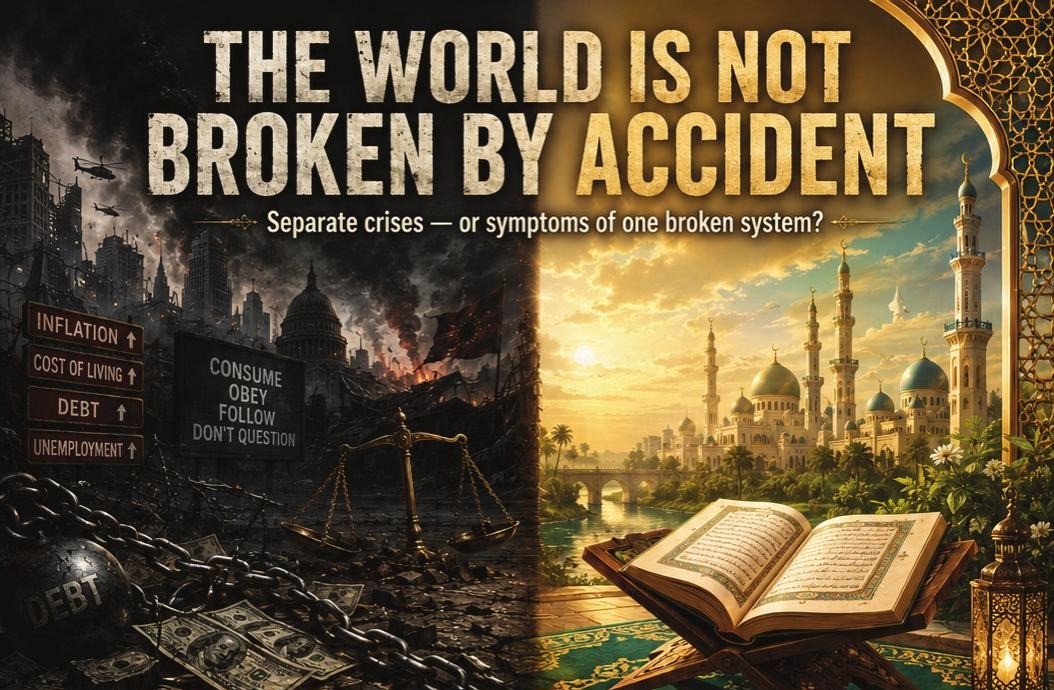
There comes a moment when a sincere person must stop pretending that everything is normal. The lived reality of ordinary people has become one of endless struggle and diminishing hope. Hardworking families struggle to afford housing, food, and other basic necessities as wages fall behind the rising cost of living and debt becomes a permanent burden.
Beyond our neighborhoods, the world bleeds.
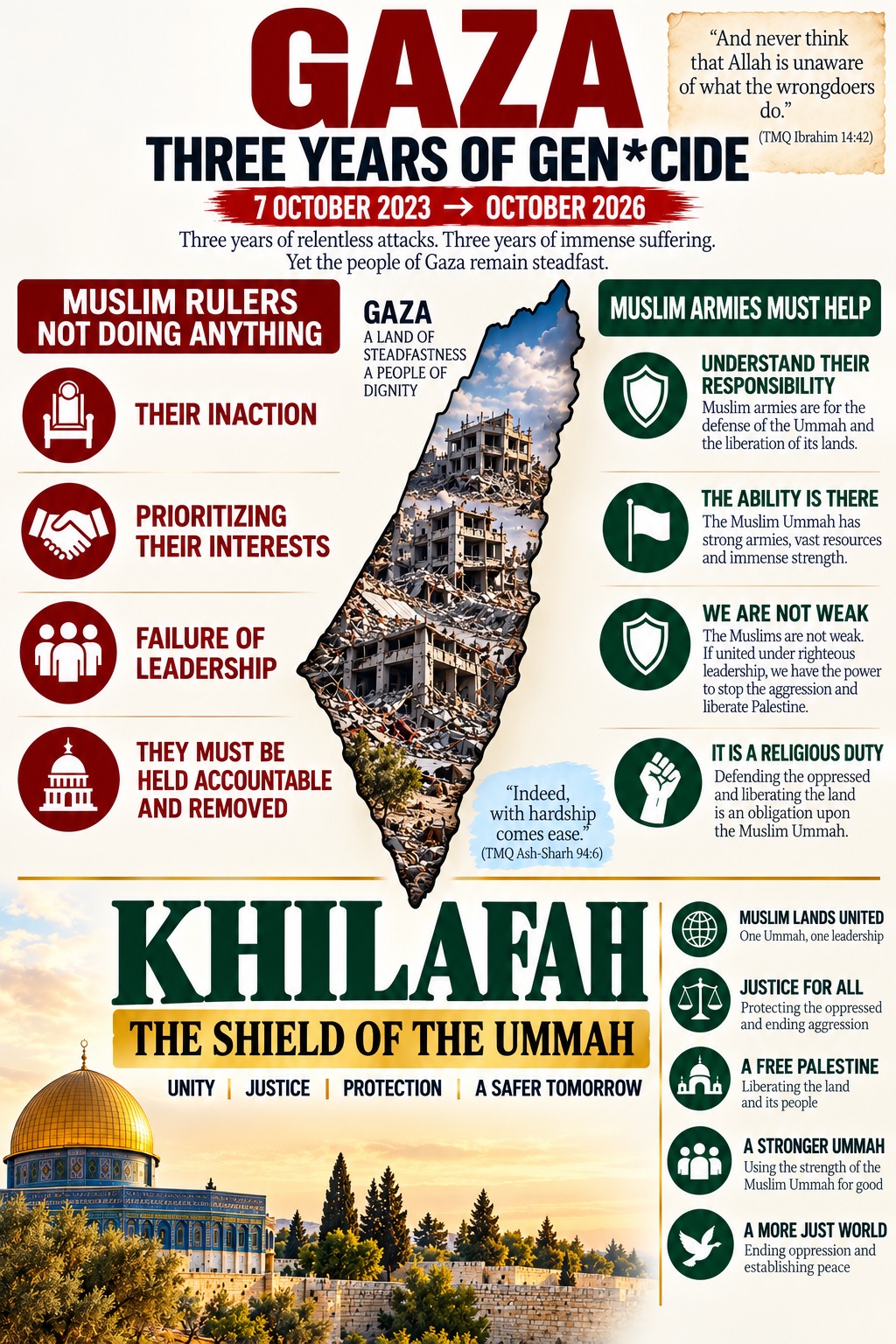
Entire populations are bombed, displaced, and starved. Parents carry the lifeless bodies of their children while genocide and destruction are broadcast before the world from Gaza and other places. Wars continue, poverty expands, morality declines, anxiety becomes normal, and trust in leadership disappears. People protest, complain, vote, and hope, yet the same suffering continues.
We must ask the question honestly: Are these separate crises, or are they symptoms of one broken system?
The world is not broken by accident. It is broken because it was built on the wrong foundation: man's ego, greed, desire, and claim that he can legislate for humanity without revelation from the Creator. It rests on the assumption that limited, emotional, and self-interested human beings can independently define justice, morality, freedom, and human purpose.
This is the root of the crisis.
Capitalism and secular democracy were presented as the final stage of human progress, promising prosperity, freedom, justice, dignity, and stability. Yet they produced economies where wealth rises upward while hardship spreads downward, political systems where people vote but powerful corporations, lobbies, financial institutions, and elites continue to shape society, and international institutions that speak of human rights while protecting aggressors and abandoning the oppressed.
The human being is increasingly treated not as a servant of Allah ﷻ with a higher purpose, but as a worker, consumer, and taxpayer. A system built upon material benefit, competition, and human desire naturally produces inequality, exploitation, and domination because justice cannot reliably emerge from interests that constantly compete for power.
People were promised that working hard, following the rules, paying taxes, voting responsibly, and remaining patient would produce a stable life. Instead, many worked harder while life became more expensive, their money lost purchasing power, and borrowing became necessary for survival. They trusted politicians only to watch powerful donors and interest groups shape policy. They were told that freedom would produce happiness, yet society increasingly suffers from addiction, loneliness, broken families, anxiety, and despair.
The hardship is not simply the result of individual failure. The deeper problem lies in a system that consumes, taxes, indebts, distracts, and exhausts people while convincing them that no serious alternative exists.
But Islam breaks that illusion.
Islam teaches that these conditions are not merely the result of bad policy, nor can they be solved simply by changing a president, party, or slogan. The problem is ideological and civilizational. Corruption is a symptom; the deeper root is that sovereignty has been taken from Divine Revelation and handed to man.
Allah ﷻ says:
إِنِ الْحُكْمُ إِلَّا لِلَّهِ
"Legislation is for none but Allah.” TMQ Yousuf: 40
The authority to legislate fundamentally belongs neither to kings, presidents, parliaments, nor elites, but to Allah ﷻ alone.
Why?
Allah ﷻ created man and knows what elevates him, what corrupts him, what protects families and societies, what disciplines desire, what restrains power, and what leads humanity toward justice in this life and success in the Hereafter.
When man assumes the right to legislate without Allah ﷻ, society becomes governed by changing desires, competing interests, money, influence, and political pressure. What is considered moral today may become immoral tomorrow, what was once condemned may become celebrated, and what was once sacred may become negotiable.
True justice must come from the One who is perfectly just.
The modern world effectively asks the patient to write his own prescription. Humanity suffers from greed, arrogance, weakness, desire, and ignorance, yet insists on designing its own cure and then acts surprised when the disease spreads.
Islam comes to end this human arrogance. It does not merely provide spiritual comfort or personal rituals; it offers a complete divine order governing how humanity lives, trades, educates, marries, judges, distributes wealth, restrains power, protects the weak, and organizes society.
Allah ﷻ says:
وَنَزَّلْنَا عَلَيْكَ الْكِتَابَ تِبْيَانًا لِكُلِّ شَيْءٍ
"And We have sent down to you the Book as clarification for all things.” TMQ An-Nahl: 89
Islam is therefore not a private religion locked inside the masjid or a spiritual addition to secular life. It guides the individual, family, economy, government, war, peace, and society. For too long, Muslims have been encouraged to shrink Islam. We confidently speak about prayer, fasting, and personal manners, yet often become uncomfortable when Islam speaks about economics, governance, sovereignty, and leadership. In doing so, we have allowed secularism to define the boundaries of our religion.
Islam came to take humanity from darkness into light.
Allah ﷻ says:
قَدْ جَاءَكُمْ مِنَ اللَّهِ نُورٌ وَكِتَابٌ مُبِينٌ يَهْدِي بِهِ اللَّهُ مَنِ اتَّبَعَ رِضْوَانَهُ سُبُلَ السَّلَامِ وَيُخْرِجُهُمْ مِنَ الظُّلُمَاتِ إِلَى النُّورِ بِإِذْنِهِ وَيَهْدِيهِمْ إِلَى صِرَاطٍ مُسْتَقِيمٍ
"There certainly has come to you from Allah a light and a clear Book, through which Allah guides those who seek His pleasure to the ways of peace, brings them out of darkness and into light by His Will, and guides them to the Straight Path.” TMQ Al-Ma'idah: 15–16
American Hegemony
Strategy Change or Policy Change?
American hegemony is one of the clearest global expressions of the secular Capitalist order described above. It represents a long pursuit of global dominance that has continued across administrations under changing public slogans such as “manifest destiny,” “the free world,” “freedom and democracy,” the “War on Terror,” and the “rules-based international order.”
Although the language changes, the tools remain familiar: military force, economic coercion, debt, sanctions, regime change, and political pressure used to protect strategic interests and preserve the dominance of secular Capitalism. Muslim communities therefore cannot mistake changes in political presentation for genuine ideological or strategic change.
The Strategic Continuum
American hegemony did not begin with the War on Terror. The United States first expanded across the continent through the seizure of Native American lands and resources before projecting similar methods abroad through wars, interventions, proxy conflicts, and economic pressure.
From the Monroe Doctrine in 1823 to modern intervention throughout the Muslim world, the strategic pattern has remained recognizable. After World War II, American power became increasingly institutionalized through bodies such as the UN Security Council, IMF, World Bank, and NATO.
The rhetoric also evolved. “Manifest destiny,” “freedom and democracy,” “human rights,” “counter-terrorism,” and “great power competition” provided moral language for policies of occupation, intervention, sanctions, and domination. The War on Terror demonstrated these methods through rendition, black sites, kill lists, proxy armies, bombing campaigns, and the political fragmentation of Muslim lands.
The empire does not necessarily reform itself out of existence; it often renames and recalibrates itself. The relevant question is therefore not simply what a policy statement says, but what military bases, economic institutions, alliances, sanctions, and strategic actions reveal.
The Engine Beneath the Empire
The consistency of American hegemony across presidents, parties, and generations is structural. Global Capitalism depends on access to markets, energy corridors, shipping lanes, resources, financial systems, and favorable political environments, all of which require protection through diplomacy, economic pressure, political interference, or military force.
American foreign policy has therefore repeatedly placed strategic and material interests above proclaimed humanitarian principles. When “freedom” aligns with strategic interests, it is loudly defended; when it contradicts them, it is reinterpreted, ignored, or abandoned.
The Democracy Double Standard
This contradiction is especially visible in the Muslim world. While democracy itself rests on man-made sovereignty, American policy reveals an additional contradiction: even its own democratic principles are applied selectively. Elections are promoted when they produce governments compatible with American interests, yet undermined when their outcomes threaten Washington's strategic objectives.
The experiences of Algeria in 1991, Palestine in 2006 and Egypt in 2013, reveal this broader contradiction. Democracy becomes less a sacred principle than a political tool whose value often depends on the result it produces.
Selective Humanitarianism
The same contradiction appears in the language of human rights. Humanitarian principles are loudly invoked against governments that challenge American dominance, while violations by strategic allies may be minimized or ignored.
Gaza stands as one of the clearest contemporary indictments. The world has watched children starve, hospitals collapse, families buried beneath rubble, and entire neighborhoods destroyed while Western governments continue to lecture humanity about international law.
Allah ﷻ warns:
وَلَا تَرْكَنُوا إِلَى الَّذِينَ ظَلَمُوا فَتَمَسَّكُمُ النَّارُ وَمَا لَكُمْ مِنْ دُونِ اللَّهِ مِنْ أَوْلِيَاءَ ثُمَّ لَا تُنْصَرُونَ
"And do not incline toward those who do wrong, lest you be touched by the Fire. For then you would have no protectors other than Allah, nor would you be helped.” TMQ Hud: 113
This guidance carries political meaning as well as spiritual meaning. Muslims must seriously examine the systems, institutions, alliances, and political structures they support and legitimize.
The Apparatus
The international architecture created after World War II is commonly presented as neutral global governance, yet its structure preserves extraordinary privileges for the most powerful states. The UN Security Council veto, international financial institutions, and military alliances allow dominant powers to shape political and economic outcomes far beyond their borders.
The Muslim world has paid a particularly high price because of its strategic geography, energy resources, population, and, above all, its Islamic ideological heritage. Colonial borders divided the Ummah, foreign powers supported compliant rulers, governments were pressured or manipulated, and Islamic movements were suppressed, infiltrated, demonized, or confined within secular political systems that prevented Islam from being implemented comprehensively.
Understanding this structure is essential because otherwise Muslims remain trapped in the politics of personalities. Presidents change, parties change, and rhetoric changes while military alliances, financial structures, strategic interests, and international institutions largely remain.
Addressing the Muslim Community
The urgent task facing Muslims in the United States and elsewhere is to develop political thinking that analyzes systems rather than personalities, strategies rather than slogans, and ideological objectives rather than electoral performances.
Allah ﷻ says:
يَا أَيُّهَا الَّذِينَ آمَنُوا كُونُوا قَوَّامِينَ بِالْقِسْطِ شُهَدَاءَ لِلَّهِ وَلَوْ عَلَى أَنْفُسِكُمْ
"O you who believe, be persistently standing firm in justice, witnesses for Allah, even if it be against yourselves.” TMQ An-Nisa': 135
Muslims should not seek merely to become comfortable or decorative minorities inside a secular Capitalist order. The Muslim Ummah carries a responsibility to present Islam as a genuine civilizational alternative and to mobilize its intellectual, cultural, and political resources toward challenging Capitalist ideology and conveying the Islamic alternative.
The Civilizational Alternative: The Khilafah
Islam as a comprehensive Deen governs worship, political authority, economics, social relations, judiciary, education, and international affairs according to Divine Revelation. It therefore presents a complete ideological alternative to the secular Capitalist order.
Allah ﷻ says:
كُنْتُمْ خَيْرَ أُمَّةٍ أُخْرِجَتْ لِلنَّاسِ تَأْمُرُونَ بِالْمَعْرُوفِ وَتَنْهَوْنَ عَنِ الْمُنْكَرِ وَتُؤْمِنُونَ بِاللَّهِ
"You are the best nation raised for mankind, enjoining what is right, forbidding what is wrong, and believing in Allah.” TMQ Al-Imran: 110
The early Muslims built a powerful civilization by applying the Islamic Aqeedah and Shari'ah to governance, judiciary, education, economics, administration, and justice. The task before Muslims today is to organize and advocate for that moral, political, and economic alternative - the Khilafah - anchored in Divine Guidance rather than Capitalist corruption, consumption, and domination.
The Mask Changes, the Empire Remains
New administrations will continue to arrive with new personalities, slogans, and policy presentations, but the Muslim Ummah must resist mistaking political choreography for strategic change. The central question is whether Muslims will remain absorbed in personalities and elections or develop the clarity, confidence, and organization necessary to work for the reestablishment of the Khilafah in the Muslim world and carry Islam as an alternative for humanity.
This work cannot be reduced to anger, empty slogans, or activism that appears with the news cycle and disappears when the headlines change. It requires serious, intellectual, political, and organized work according to the method of the Prophet صلى الله عليه وسلم that challenges the ideological roots of Capitalism, secularism, nationalism, and man-made sovereignty.
We cannot remain spectators while the world burns, nor can we watch the collapse of family, morality, economy, education, and global justice while reducing Islam to private worship. The time for passive complaint has ended, and the responsibility now is to develop conscious, organized work rooted in Islam.
Allah ﷻ says:
وَقُلْ جَاءَ الْحَقُّ وَزَهَقَ الْبَاطِلُ إِنَّ الْبَاطِلَ كَانَ زَهُوقًا
"And say, 'Truth has come and falsehood has departed. Indeed falsehood, by its nature, is bound to depart.’" [TMQ Al-Isra': 81]